
0%

Railway Variable Frequency Drives control the speed and torque of electric motors by adjusting the frequency and voltage supplied to them. In rail vehicles, related power-electronic converters can drive traction motors or support onboard systems such as pumps and ventilation fans. The exact arrangement depends on the vehicle, motor, and electrical supply. Details vary.

A traction drive must respond smoothly as a train starts, climbs, brakes, and changes speed. For example, a driver’s acceleration command may prompt the control system to increase motor torque while monitoring current and temperature. These systems can also support regenerative braking, where suitable equipment returns some energy to the supply network. Performance depends on the complete electrical system, not one component alone.

Understanding Railway Variable Frequency Drives means looking beyond speed control. Engineers also consider insulation, cooling, vibration, electromagnetic compatibility, protection functions, and maintainability. A drive operating beneath a railcar faces space limits and repeated mechanical stress; a wayside installation has different environmental demands. Specifications and test results matter. So does service experience. Yet no overview can replace vehicle-specific design data, and terminology may differ between manufacturers. That uncertainty is worth acknowledging. This introduction sets out the basic operating principles, common railway applications, key design considerations, and practical questions readers can use when evaluating a drive system.
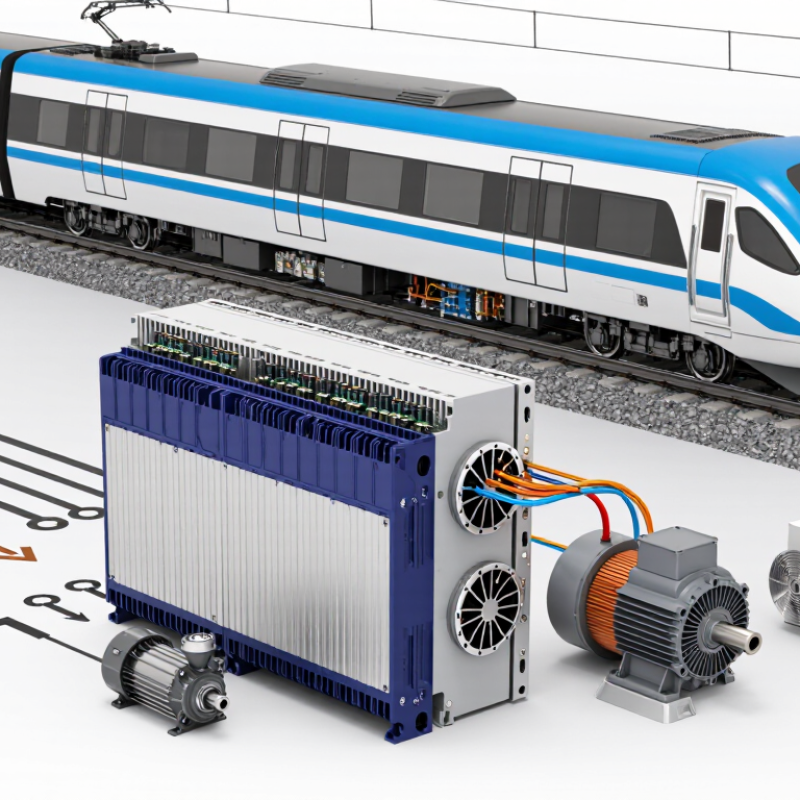
What Is a Railway Variable Frequency Drive?

What a Railway Variable Frequency Drive Is

A railway variable frequency drive (VFD) is a power-electronic system that controls the speed and torque of traction motors. It adjusts the frequency and voltage supplied to an AC motor. In a typical electric train, power passes through a converter and a DC link before the inverter delivers controlled AC to the motor. The drive also monitors current, temperature, and faults. It must respond smoothly as a train accelerates, climbs, or slows.

The International Energy Agency’s The Future of Rail (2019) reports that rail carries 8% of global passenger transport and 7% of freight, while using 2% of transport energy. Those figures describe rail overall, not the savings from VFDs. Still, they show why efficient traction matters. During regenerative braking, a drive can operate the motor as a generator and return energy to the electrical system, when the train and infrastructure can accept it. A detail is easy to miss.

IEC 61287-1 sets characteristics and test methods for power converters installed on rolling stock. In service, railway drives also face vibration, temperature swings, and demanding electrical conditions. Their performance depends on the motor, control settings, cooling, and operating pattern—not the drive alone. A VFD is not a magic efficiency box. Measuring energy use on the actual route remains important.

What Is a Railway Variable Frequency Drive?

A railway variable frequency drive (VFD) controls an AC motor by varying the frequency and voltage of its electrical supply. This chart shows the relationship between supply frequency and the synchronous speed of a four-pole motor.

For a four-pole motor, synchronous speed is calculated as 120 × frequency ÷ pole count. Actual induction-motor speed is slightly lower under load because of slip. Values illustrate the motor-speed relationship, not a specific train or drive.

How a Railway Variable Frequency Drive Controls Motor Speed

What Is a Railway Variable Frequency Drive?

How a Railway Variable Frequency Drive Controls Motor Speed

A railway variable frequency drive regulates the electrical power supplied to a traction motor. It converts incoming power into controlled voltage and frequency. Changing frequency changes the motor’s rotating magnetic field and, in turn, its speed. The drive adjusts voltage alongside frequency to maintain useful torque. During acceleration, it can increase output smoothly, helping prevent sudden jolts in the carriage. Sensors may feed back motor speed and current, allowing the control system to respond to changing loads, gradients, and wheel conditions. The principle is straightforward; tuning it reliably is not.

The International Energy Agency’s 2019 report, The Future of Rail, states that rail carries 8% of passenger transport and 7% of freight transport globally, while using 2% of transport energy. That figure describes rail overall, not savings from variable frequency drives. A drive can also support regenerative braking, when the system can accept returned electricity. Benefits depend on the train, route, and power network. Real operating conditions are messier than a test track.

Tips: Compare motor current and speed logs across acceleration and braking. Check for unusual temperature or vibration, too. Don’t assume every braking event returns energy; confirm that the electrical system can receive it.

Key Components of a Railway Variable Frequency Drive

A railway variable frequency drive (VFD) controls the frequency and voltage supplied to traction motors, helping regulate train speed and torque. Its components work together under vibration, electrical load, and changing temperatures. The exact arrangement varies by train, so a component list alone can miss important design differences.

The input stage conditions power from the supply or onboard transformer. A converter then feeds a DC link, where capacitors smooth voltage fluctuations. The inverter uses switching devices to produce three-phase power at controlled frequency. Sensors monitor current, voltage, and temperature; a controller adjusts switching to meet traction demand. Cooling channels remove heat from power electronics, while protective circuits respond to faults.

Small parts matter. A loose connection can disrupt reliable operation.

The IEA’s 2019 report, The Future of Rail, estimates that rail carries 8% of global passenger transport and 7% of freight, while using 2% of transport energy. That scale makes efficient traction systems significant, though the report does not measure VFD performance specifically. Engineers should assess the complete drive, including motor, cooling, and control behavior.

Heat is relentless. A tidy schematic does not prove field reliability.

Where Railway Variable Frequency Drives Are Used

Railway variable frequency drives are used wherever a train needs controlled motor speed and torque. Their most visible role is in electric traction systems, where they regulate power to AC traction motors. During acceleration, a driver may feel smooth, steady pull rather than abrupt jolts. During braking, some trains can return electrical energy to the supply system, depending on their design and infrastructure.

They also operate less noticeable equipment. Onboard HVAC systems use drives to adjust fan and compressor speeds as passenger loads and outside temperatures change. Pumps and ventilation fans may use them too, including in engine rooms or under-floor equipment spaces. The difference is tangible. A fan that responds to demand can avoid running at full speed when it is not needed. In depots, variable frequency drives may control workshop pumps, extraction fans, or test equipment.

Conditions vary. Dust, vibration, temperature swings, and limited space can affect drive installation and service life. Maintenance teams typically check cooling paths, electrical connections, and fault records; a blocked filter can matter more than expected. Not every motor benefits from variable-speed control, either. Compatibility and the operating profile need review. It is easy to focus on energy savings, but reliability and access for repairs deserve equal attention.

Operational Benefits and Design Challenges of Railway Drives

What Is a Railway Variable Frequency Drive?
Operational Benefits and Design Challenges of Railway Drives

A railway variable frequency drive (VFD) controls traction motor speed by adjusting electrical frequency and voltage. This lets a train deliver strong starting torque, then regulate speed without relying on fixed motor operation. During braking, compatible drive systems can send energy back to the supply or onboard storage. The benefit depends on whether the network can accept that energy. Small details matter: wheel slip, frequent stops, and timetable changes all affect performance.

The IEA’s 2019 report, The Future of Rail, estimated that rail carried 8% of global passenger movement and 7% of freight movement, while using 2% of transport energy. That is useful context, not a VFD-specific savings claim. Drive design must also handle vibration, dust, temperature swings, and electromagnetic interference. Engineers often check these conditions against railway standards such as IEC 61373 and IEC 60571. A compact cabinet may fit beneath a car, but restricted cooling can raise component temperatures during long climbs. Regenerative braking can also create voltage-management challenges when other trains are not drawing power. The trade-off is real. Energy gains are not automatic; measurement across actual routes is still essential.

FAQS

What does a railway variable frequency drive do?

It controls the voltage and frequency supplied to a traction motor. Changing frequency adjusts motor speed, while voltage helps maintain useful torque.

How does it make acceleration smoother?

The drive can raise its output gradually, reducing sudden jolts in the carriage. The tuning still takes care.

What main parts are inside a railway drive?

An input stage conditions power, and a converter feeds a DC link. Capacitors smooth voltage; an inverter supplies controlled three-phase power.

How does the drive respond to changing conditions?

Sensors can monitor motor speed, current, voltage, and temperature. The controller uses these readings to adjust power as loads or gradients change.

Can braking return electricity to the system?

Regenerative braking can send electricity back when the electrical system can accept it. Not every braking event returns usable energy.

What can affect drive performance?

The motor, cooling, route gradients, wheel conditions, and power network all matter. Test-track results may not reflect daily service.

What signs should maintenance teams watch?

Compare motor-current and speed logs during acceleration and braking. Check for unusual heat, vibration, or loose connections.

Why is cooling important?

Cooling channels remove heat from power electronics under heavy electrical loads. Heat adds up. A neat schematic cannot prove reliable field operation.

Conclusion

Railway Variable Frequency Drives are power-electronic systems that regulate the speed and torque of electric motors used in rail vehicles and railway equipment. By adjusting the frequency and voltage supplied to a motor, a drive can support smooth acceleration, controlled braking, and efficient operation across changing conditions. A typical system includes power-conversion circuits, control electronics, sensors, cooling equipment, and protective components that work together to manage energy and monitor performance.

These drives are used in applications such as train traction, ventilation, pumps, and other auxiliary systems. They can improve energy efficiency, reduce mechanical stress, and provide more precise motor control. Railway designs must also account for vibration, temperature changes, limited installation space, electrical interference, and demanding reliability requirements. Careful integration and maintenance help ensure that a drive performs consistently throughout its service life.

Amelia

Amelia

Amelia is a professional marketing specialist with a deep understanding of the company’s products, customers, and industry landscape. With a strong background in content strategy, market research, and digital communication, she transforms complex product information into clear, practical, and......