
EN 50155 Certified Power Electronics

Catenary DC/AC Inverters for Rolling Stock & Railway Auxiliary Power Systems: The Technical & Procurement Guide (750V, 1500V & 3000V DC)

A comprehensive engineering breakdown on selecting, integrating, and procuring heavy-duty Catenary DC/AC Inverters. Discover how modern wide-bandgap SiC power stages, planar magnetics, and dynamic surge protection guarantee 30-year operational life across high-voltage railway networks globally.

  • EN 50155, EN 45545-2 (HL3) & EN 61373 Railway Certification
  • 750 VDC, 1500 VDC & 3000 VDC High-Voltage Catenary Capability
  • In-House Thermal, EMC & Planar Magnetics Engineering in Barcelona
  • Over 1,000 Custom Power Projects & 40+ Years Industry Leadership
Technical Deep Dive & Engineering Insight

Understanding Catenary DC/AC Inverter Architecture under Extreme Line Voltage Dynamics

In electric railway rolling stock—ranging from urban metros and light rail transit (LRT) to high-speed regional trains—catenary DC/AC inverters serve as the vital power conversion bridge between raw overhead catenary lines or third rails and onboard electrical loads. Designing power electronics capable of withstanding real-world catenary conditions requires addressing extreme electrical transients, thermal limits, and harsh vibration profiles.

The Challenge of Catenary Line Fluctuations (EN 50163 Standard Compliance)

Unlike stationary industrial AC grids that maintain stable voltages within strict ±5% or ±10% tolerances, railway overhead catenary systems exhibit severe voltage fluctuations driven by train acceleration, regenerative braking, substation distance, and pantograph contact bounce. According to European Norm EN 50163 (Railway applications – Supply voltages of traction systems), nominal DC catenary voltages experience wide continuous and transient operating envelopes:

  • 750 VDC Nominal Systems: Continuous working ranges from 500 VDC to 1000 VDC, with non-permanent voltage surges reaching up to 1270 VDC during regenerative braking spikes.
  • 1500 VDC Nominal Systems: Continuous working windows spanning 1000 VDC to 1950 VDC, with short-duration transients climbing up to 2540 VDC.
  • 3000 VDC Nominal Systems: Operational ranges between 2000 VDC and 3800 VDC, facing severe inductive switching spikes exceeding 4500 VDC.

Standard off-the-shelf industrial inverters instantly fail under such severe overvoltage stresses or trigger undervoltage lockouts during rapid pantograph disconnects. Premium PSU’s Catenary DC/AC Inverters incorporate multi-stage active surge suppressors, high-energy clamping networks, and wide-input resonant topologies designed specifically to absorb these high-energy transients without interrupting secondary AC outputs.

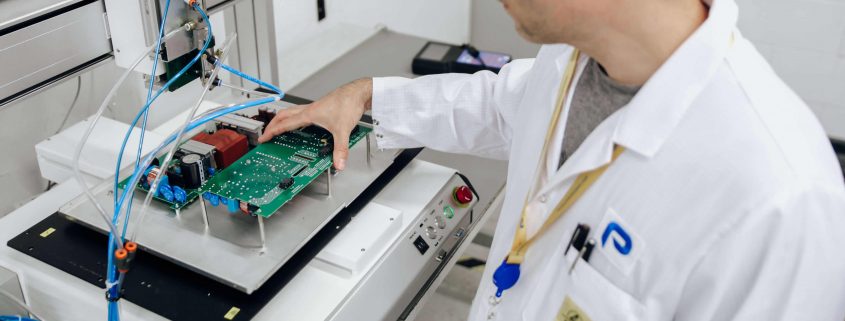
Premium PSU engineering laboratory testing catenary DC/AC inverters under simulated EN 50163 transients

Galvanic Isolation & Insulation Coordination (EN 50124-1)

Catenary DC inputs operate directly connected to track ground reference, introducing high common-mode interference and dangerous fault currents. High-performance railway catenary inverters must feature high galvanic isolation—often exceeding 3.5 kV AC or 5.6 kV DC breakdown strength between primary DC rails, secondary AC outputs, and chassis earth. Premium PSU employs planar transformer geometries with reinforced insulation distance (creepage and clearance per EN 50124-1 Pollution Degree 3), eliminating arc-over risks in damp or conductive dust environments.

Harmonic Distortion (THD) & Pure Sine Wave Generation

Onboard auxiliary loads—such as variable-speed HVAC compressors, main engine cooling blowers, battery chargers, emergency lighting, and sensitive train control networks—require clean, highly stable AC power. Premium PSU’s digital signal processor (DSP) controlled inverter bridge utilizes Space Vector Pulse Width Modulation (SVPWM) paired with active multi-stage L-C output filters. This guarantees a Total Harmonic Distortion (THD) of less than 2% for linear loads and less than 3% for non-linear loads, preventing motor overheating and acoustic noise generation.

Standard Platforms & Engineered Product Selection

Recommended Catenary DC/AC Inverter Models for Rolling Stock Applications

Whether you require single-phase standalone subrack modules or heavy-duty three-phase auxiliary power supplies (APS) for passenger cars, Premium PSU delivers catalog-proven platforms that shorten NRE development timelines and de-risk rolling stock engineering schedules.

OVX-6400 Series 3-Phase Railway Catenary DC/AC Inverter
High-Power 3-Phase Inverter

OVX-6400 Series Railway Inverter

Delivering up to 6.4 kVA continuous power (or parallelable up to 38 kVA), the OVX-6400 series converts high-voltage catenary DC inputs directly into clean 400 VAC 3-phase output for train HVAC systems, air compressors, and main cooling fans. Engineered to meet EN 50155, EN 45545-2 (HL3 fire safety), and EN 61373 shock/vibration compliance.

  • Input: Wide 750 VDC / 1500 VDC ranges
  • Output: 400 VAC 3-Phase 50/60 Hz pure sine wave
  • Efficiency: > 94.5% at rated load
  • Cooling: Conduction / Forced-air aluminum heatsink
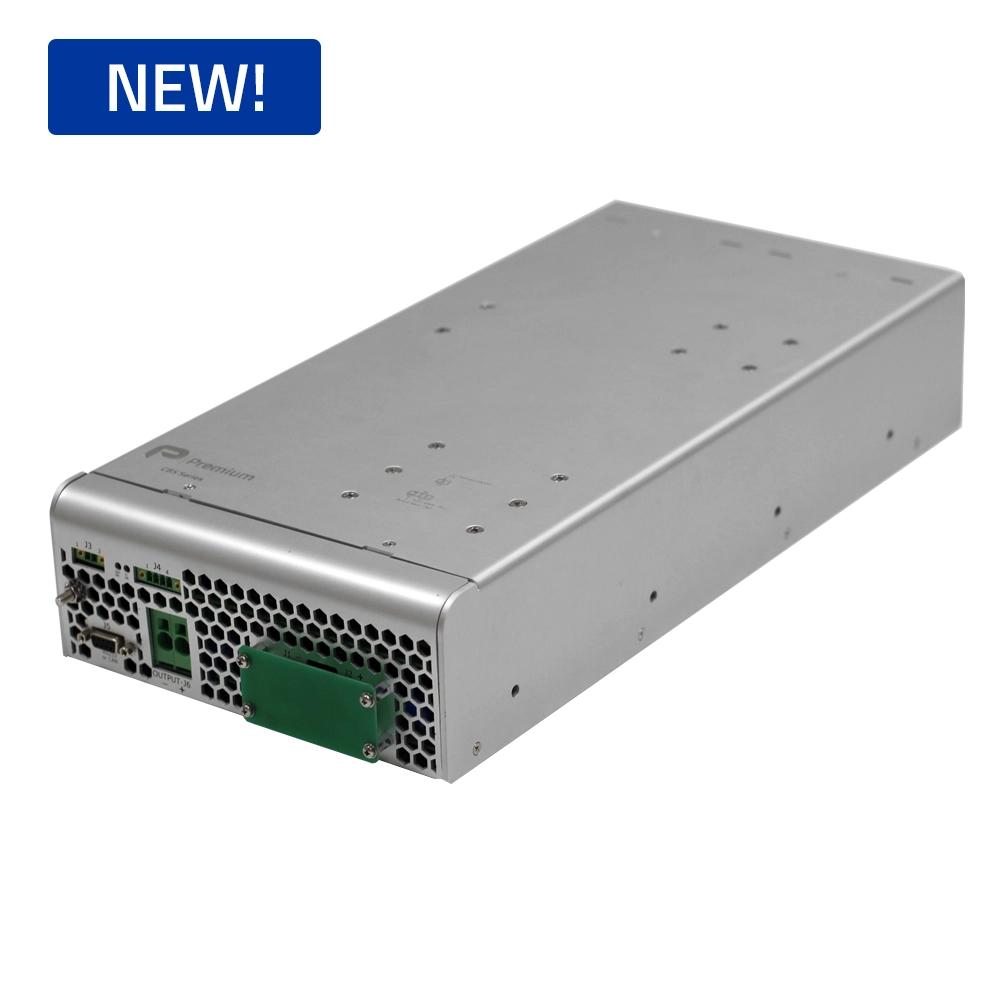
CBS-10K Railway DC/DC & Auxiliary Inverter Platform
Multi-Output Auxiliary Power

CBS-10K High Peak Inverter System

Designed for demanding pulse-load profiles such as door actuators, pantograph pneumatic pumps, and emergency hydraulic braking units. The CBS-10K provides 10 kW peak overload capacity for up to 5 seconds, featuring dynamic overload management without tripping onboard breakers.

  • Peak Power: 10 kW transient handling
  • Galvanic Isolation: 3000 VAC input-to-output
  • Rugged Enclosure: IP65 aluminum chassis
  • CANbus & Ethernet Telemetry Monitoring
OCS-3000 Modular Railway Inverter Platform
1-Phase & 3-Phase Modular

OCS-3000 Modular Inverter Platform

A compact 3000 VA rack-mount catenary inverter featuring active CANbus load sharing, allowing up to 6 units to operate in N+1 redundancy. Ideal for passenger cabin socket power (120 V / 230 V), cab electronics, and onboard Wi-Fi / infotainment servers.

  • Input Range: 750 VDC (400V–1100V continuous)
  • Sinusoidal THD: < 1.8% at full resistive load
  • Static Transfer Switch (STS) sync compatible
  • Operating Temp: -40°C to +85°C (OT4 Class)
Custom Engineered Auxiliary Power Supply System for Catenary Lines
Turnkey Custom APS

Custom Catenary Auxiliary Systems

Tailor-made Auxiliary Power Supply (APS) cubicles integrating catenary DC/AC inverters, low-voltage DC/DC converters, and integrated battery chargers inside a single IP66 underfloor or rooftop envelope for high-speed trains, locomotives, and metro cars.

  • Power Range: 10 kW to 72 kW integrated
  • Custom mechanical envelope matching train frame
  • Integrated planar magnetics & SiC devices
  • Complete FAI and type testing package
Strategic Market Insights & R&D Vectors

As global rail transit operators accelerate decarbonization, energy efficiency goals, and digital fleet monitoring, procurement managers and rolling stock chief engineers must evaluate upcoming technological vectors to ensure long-term equipment compatibility and low Total Cost of Ownership (TCO).

Next-Gen Semiconductors

1. Transition to Silicon Carbide (SiC) MOSFET Topology

Traditional silicon-based IGBT inverters exhibit switching loss bottlenecks that limit operating frequencies to 8–12 kHz, necessitating bulky filter inductors and heavy isolation transformers. Modern catenary inverters are rapidly transitioning to Silicon Carbide (SiC) wide-bandgap semiconductors. Operating at switching frequencies above 40–100 kHz, SiC-based catenary inverters reduce switching losses by up to 55%, boost system conversion efficiency beyond 96.5%, and decrease passive component volume by 40%. This allows rolling stock designers to save critical rooftop and underfloor space while cutting train overall tare weight.

Modularity & Redundancy

2. Hot-Swappable N+1 Redundant Architectures

Unplanned train withdrawal due to single-point power converter failure results in severe financial penalties for rail operators. The market is shifting heavily toward modular subrack catenary inverters with active digital load sharing. In an N+1 redundant installation, if one inverter module experiences an internal thermal or semiconductor fault, integrated static transfer switches (STS) dynamically isolate the affected module within microseconds. The remaining units instantaneously pick up the load without output voltage interruption, enabling train service completion before maintenance intervention.

Digitalization & Predictive Maintenance

3. Integration of IoT Gateways & Digital Twin Telemetry

Procurement specifications increasingly mandate real-time health supervision rather than calendar-based maintenance schedules. Modern catenary inverters integrate smart IoT communication modules (such as the Premium Vision Gateway) that stream high-frequency operational telemetry—including DC input voltage ripple, electrolytic capacitor ESR degradation indicators, switching temperature profiles, and total operational hours—directly to train management systems (TCMS) or cloud-based maintenance dashboards. Maintenance crews can predict component wear months before an operational failure occurs.

4. Strict Fire & Smoke Standard Alignment (EN 45545-2 HL3)

Safety regulations inside railway tunnels and underground metro systems have tightened globally. Catenary inverters mounted onboard passenger cars or inside driver cabs must strictly comply with EN 45545-2 hazard level HL3 (the highest severity level). Premium PSU ensures that all internal conformal coatings, printed circuit boards (PCBs), potting compounds, wiring harnesses, and structural seals use halogen-free, self-extinguishing materials certified for low toxicity and flame resistance under extreme thermal stress.

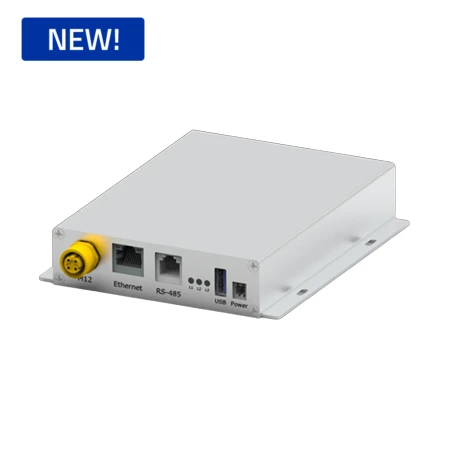
Premium Vision IoT Communication Module for Remote Catenary Inverter Diagnostics
Why OEM Integrators Partner With Premium PSU

40+ Years of Railway Power Electronics Engineering Excellence in Barcelona

Founded in 1984, Premium PSU has established itself as an authoritative leader in custom and standard power conversion systems for demanding industrial, transportation, energy, and defense sectors. Our engineering rigor guarantees that your catenary inverter project exceeds performance, safety, and longevity expectations.

  • Deep Normative Competence & In-House Testing Our engineering campus in Barcelona features a state-of-the-art test laboratory equipped for full Electromagnetic Compatibility (EMC per EN 50121-3-2), thermal cycling in climatic chambers (-40°C to +85°C), insulation breakdown testing, and high-frequency burn-in screening. This internal capability dramatically reduces prototype iteration time and guarantees first-pass success during official third-party type tests.
  • Planar Magnetics Integration & Custom Mechanical Enclosures We design custom planar transformers and inductors in-house. By embedding planar windings directly into multi-layer heavy-copper PCBs, we eliminate manual wire-winding variations, drastically improve thermal dissipation against cold-plates, and achieve power densities unachievable with traditional bobbin magnetics.
  • 20+ Year Obsolescence Management & Fleet Lifecycle Support Railway fleets are designed to remain in revenue service for 30 to 40 years. Premium PSU offers structured long-term component lifecycle monitoring, last-time-buy notifications, form-fit-function replacement redesigns, and dedicated repair services to keep installed catenary inverter fleets operational without expensive coach retrofits.
  • Proven Global Track Record with Tier-1 OEMs Over 1,000 custom design programs delivered and 260+ standard platforms deployed across 5 continents. Trusted by global railway and energy leaders including Alstom, Siemens, CAF, Vestas, Iberdrola, and Endesa.
Premium PSU Barcelona Engineering Center R&D Team

Enterprise Fast Facts:

  • 130+ Dedicated Power Electronics Specialists in Barcelona
  • ISO 9001, ISO 14001 & IRIS (ISO/TS 22163) Quality Framework
  • 10+ Years Average Customer Partnership Longevity
  • 100% European R&D and Manufacturing Integrity
Proven Industry Leadership

Trusted by Global Railway Builders & System Integrators

Our catenary inverters and power conversion modules are integrated into flagship locomotives, metro cars, and power substations worldwide.

  • Alstom Railway Systems
  • ASML High-Tech Power Systems
  • Siemens Mobility
  • Vestas Energy Systems
  • Iberdrola Utility Power
  • Endesa Energy Group
  • CAF Rolling Stock Manufacturer
  • Naturgy Energy Group
Technical Procurement FAQ

Frequently Asked Questions by Global Railway Engineers & Procurement Managers

Addressing the core technical and operational questions asked during catenary inverter selection and RFQ processes.

1. What are the key differences between standard industrial DC/AC inverters and railway-grade Catenary DC/AC Inverters?
Industrial DC/AC inverters are designed for stable DC bus lines (such as 48 V, 110 V, or 400 V stationary battery banks) with narrow input voltage tolerances (±10% to ±15%) and moderate ambient conditions. In contrast, Catenary DC/AC Inverters connect directly or semi-directly to high-voltage traction catenaries (750 VDC, 1500 VDC, 3000 VDC per EN 50163) which suffer from severe transients, contact interruptions, and voltage surges up to 4500 VDC. Furthermore, catenary inverters must strictly comply with railway-specific standards: EN 50155 for electronic equipment, EN 45545-2 for fire & smoke safety (HL3 level), EN 61373 for extreme shock and vibration, and EN 50124-1 for high creepage/clearance insulation coordination.
2. How does Premium PSU handle thermal dissipation in unventilated or space-constrained railway compartments?
We specialize in conduction-cooled (cold-plate) and natural convection designs. By using high-efficiency Silicon Carbide (SiC) switching devices and planar transformers, we minimize internal thermal dissipation. Cold-plate chassis models allow heat to be conducted directly to the train frame or external underfloor heat sinks, eliminating fan maintenance and preventing dust ingress into sealed IP65/IP66 power enclosures.
3. What is the typical NRE cost and turnaround time for a custom-engineered catenary inverter program?
By utilizing our pre-qualified building block topologies—such as standard planar magnetic matrices, proven DSP control algorithms, and pre-tested mechanical housings—a custom catenary inverter development program typically moves from initial spec alignment to qualified prototype delivery in 16 to 28 weeks. Standard catalogue platforms like the OVX-6400 can be sampled even faster. NRE costs are optimized based on project volume and reuse of modular IP.
4. Can Premium PSU catenary inverters operate in parallel for higher power or redundant configurations?
Yes. Our catenary inverters incorporate high-speed active CANbus droop or active current sharing control. Up to 6 units can be connected in parallel to achieve total power capacities exceeding 38 kVA, while supporting true N+1 active redundancy. Integrated static transfer switches guarantee seamless hot-standby switching without interruption to downstream AC equipment.
5. How are short-circuit and motor inrush currents managed by the inverter digital controller?
HVAC compressors and industrial motor loads draw severe starting inrush currents (often 5 to 7 times continuous rated current). Premium PSU catenary inverters feature real-time cycle-by-cycle digital current limiting. The controller automatically transitions into constant-current regulation mode during motor startup, supplying full peak torque without tripping output breakers or collapsing the AC sine wave voltage.
6. What environmental protection measures are applied to ensure 30-year operational life?
All internal printed circuit boards undergo automated Class 3 acrylic or polyurethane conformal coating protecting components against humidity, condensation, conductive carbon brake dust, and airborne contaminants. Heavy aluminum chassis feature chromate conversion pre-treatment and industrial-grade powder coating capable of surviving 1,000+ hours of salt-spray testing per EN 60068-2-11.
7. How do I request customized CAD models, compliance documentation, or type-test reports?
You can directly consult our application engineering team by clicking the Get a Quote button or using our digital Product Selector. We provide complete STEP 3D models, technical datasheets, FAI documentation, MTBF calculations (per IEC 61709 / MIL-HDBK-217F), and standard test certificates upon request.

Discuss Your Catenary Inverter Specification with Senior R&D Engineers

Need a custom input range, specific mechanical footprint, or certified 3-phase auxiliary power unit for an upcoming rolling stock tender? Our Barcelona engineering team is ready to analyze your mission profile.