
China Top Catenary DC/AC Inverters? This question deserves more than a factory list. It requires technical verification, application experience, and transparent supplier comparison. China’s railway expansion has created strong demand for reliable traction-power equipment. According to China State Railway Group’s 2023 annual information, China operated more than 159,000 kilometers of railway lines, including over 45,000 kilometers of high-speed rail. This extensive network creates demanding conditions for Catenary DC/AC Inverters, especially in substations, test systems, and regenerative-energy applications.
The International Energy Agency’s Global EV Outlook 2024 reported that China represented more than half of global electric-car sales in 2023. Although electric vehicles and railways use different power architectures, both sectors increase pressure on power-conversion efficiency, thermal management, and grid stability. Suppliers should therefore demonstrate measured efficiency, overload capability, harmonic performance, and long-term service records. Relevant references include IEC 62477-1, EN 50163, and the EN 50126/50128/50129 railway safety framework. Certification alone is not enough.
Look closely at the details. A dependable inverter should operate steadily beside vibrating track equipment, changing loads, dust, and limited maintenance access. Buyers should request factory test reports, third-party certificates, failure-rate data, and customer references from comparable voltage systems. Leading Chinese manufacturers may offer cost advantages, customization, and shorter production cycles. Yet supplier rankings can be subjective, and public performance data remains uneven. That weakness matters. This guide will compare manufacturers through engineering capability, product reliability, compliance evidence, delivery experience, and after-sales support, rather than promotional claims alone.
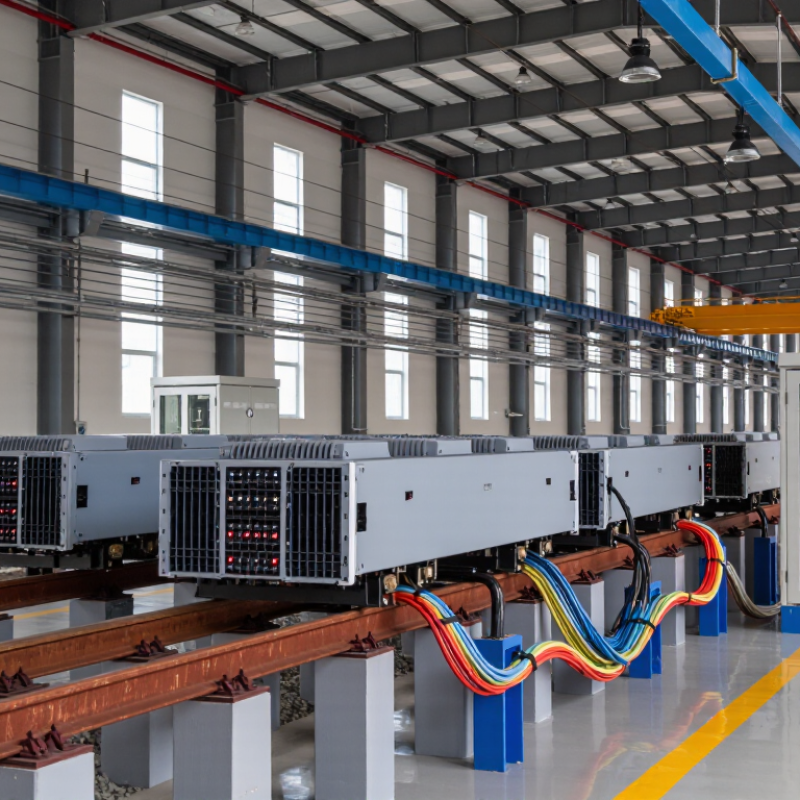
A catenary DC–AC inverter converts direct current from an overhead railway line into controlled alternating current. This power drives traction motors, compressors, cooling fans, and onboard auxiliary systems. The inverter rapidly switches semiconductor devices, then shapes voltage and frequency for smooth motor control. Modern units may use IGBT or silicon-carbide modules. The choice affects efficiency, heat, noise, and maintenance.
Railways need this technology because operating conditions change constantly. Trains start under heavy load, climb gradients, and brake repeatedly. A well-designed inverter manages torque precisely and can support regenerative braking. The International Energy Agency’s The Future of Rail reports that rail carries about 8% of global passenger travel and 7% of freight movement, while using roughly 2% of transport energy. These figures explain the value of efficient traction conversion. However, real performance depends on line voltage, cooling design, train weight, and maintenance quality. The term is sometimes used too loosely.
Tips: Check the inverter’s input range, overload rating, cooling method, and harmonic performance. Ask for test data under dusty, humid, and low-temperature conditions. IEC 61287-1 provides useful guidance for railway power converter ratings and operating characteristics. Field experience matters more than a polished efficiency number. A small measurement gap can become a large service problem.
China Top Catenary DC AC Inverter Manufacturers?
How Catenary DC–AC Inverters Operate in Railway Systems
A catenary DC–AC inverter links a railway’s overhead DC supply with an AC traction network or utility grid. Power enters through an input filter and protection stage. A DC link then stabilizes voltage inside the converter. Semiconductor switches create controlled three-phase AC output. Pulse-width modulation shapes the waveform and limits harmonic distortion. The controller also matches voltage, frequency, and phase before grid connection. That distinction matters.
During braking, the traction motor can operate as a generator. Energy flows back through the traction converter into the DC catenary. A reversible inverter can transfer this energy to an AC network, reducing resistor-based heat loss. The IEA’s Future of Rail report states that rail moves about 8% of global passengers and 7% of freight, while using roughly 2% of transport energy. Even small efficiency gains can therefore affect large operating networks. Practical systems also monitor insulation, current peaks, temperature, and neutral sections under EN 50163 voltage requirements.
Real performance depends on timetable density, line voltage, and grid acceptance capacity. A lightly loaded corridor may recover less braking energy than expected. Field results are not perfectly uniform. Inverter efficiency, often assessed near its rated operating point, can fall during low-load switching. Maintenance teams therefore inspect cooling channels, waveform quality, and event logs rather than trusting one laboratory figure. Industry guidance from UIC energy-efficiency studies repeatedly treats regenerative braking, metering, and system coordination as connected issues, not isolated equipment features.
Railway inverters adapt electrical power from different catenary systems into controlled AC power for traction motors and onboard auxiliary equipment. The chart compares common nominal railway supply voltages; actual values depend on the railway network and operating standard.
When evaluating Chinese manufacturers of catenary DC AC inverters, begin with technical evidence, not attractive catalog images. Request complete datasheets showing input voltage range, output waveform, efficiency, overload capacity, and protection functions. A reliable supplier should explain performance at low temperatures, high humidity, and changing rail loads. Ask for test records, not only laboratory promises.
Factory experience matters. Review production history, engineering staff, and quality-control procedures. Check whether each inverter receives insulation, thermal, vibration, and electromagnetic compatibility testing. Traceable serial numbers and documented calibration improve confidence. Relevant certifications should match the destination market and application. Still, certificates alone cannot prove long-term field reliability.
Visit the facility when possible, or arrange a live video audit. Observe incoming inspection, soldering control, burn-in stations, and final testing. Ask how failures are analyzed and how design changes are approved. Clear answers usually reveal technical maturity. Communication also deserves testing: send a detailed operating profile and compare the response with your own requirements. Some manufacturers react quickly but provide shallow calculations. That is a warning.
A practical supplier should offer sample units, realistic lead times, spare-part planning, and accessible after-sales engineers. Warranty language must define repair responsibilities and response periods. I would also compare efficiency after continuous operation, not just at the rated point. No evaluation is flawless. Even experienced buyers can overlook software behavior during sudden load changes. Leave room for independent testing before large-scale deployment.
China’s leading catenary DC–AC inverter manufacturers serve rail transit, maintenance vehicles, and specialized power systems. Their strongest products begin with accurate catenary input analysis. Voltage fluctuations, regenerative surges, and short interruptions can stress poorly designed equipment. Experienced manufacturers therefore specify wide input ranges, controlled start-up circuits, and reinforced electrical isolation. Stable output matters most.
A reliable manufacturer should provide test records, thermal data, and clear protection settings. Look for overload response, short-circuit behavior, insulation strength, and electromagnetic compatibility results. Engineers should also examine the inverter’s cooling path. Dusty depots and enclosed cabinets can raise internal temperatures quickly. Forced-air cooling may help, but it can increase maintenance needs. Passive cooling is quieter, yet sometimes less compact.
Factory capability is not only about production volume. It includes firmware validation, component traceability, and repeatable end-of-line testing. In field evaluations, waveform distortion and switching noise often reveal weaknesses before a major failure occurs. Ask for practical evidence, not attractive specifications. No supplier gets every detail right. Some documentation may still require clarification. That is a useful warning, not a minor inconvenience. Manufacturers willing to explain limitations usually support safer integration, easier commissioning, and more dependable service planning.
Catenary DC AC inverters support railway traction, metro systems, tram networks, and onboard auxiliary equipment. They convert unstable DC power into controlled AC power for motors, pumps, compressors, lighting, and communication systems.
In regenerative braking applications, the inverter must respond quickly to changing voltage and load conditions. A small delay can affect system efficiency and thermal performance.
Certification review should match the actual railway environment.
Buyers commonly examine IEC standards, EN 50155 for electronic equipment, EN 50121 for electromagnetic compatibility, and EN 45545 for fire protection.
ISO 9001 certification can indicate controlled production processes, but it cannot replace product testing.
Ask for type-test reports, insulation data, EMC results, vibration tests, and temperature-cycle records. Documentation matters.
Real conditions are less tidy. Tunnel heat, dust, altitude, and limited ventilation can reduce output capacity.
A laboratory efficiency figure may not represent summer operation inside a sealed cabinet.
Check the DC input range, overload capacity, switching frequency, cooling method, protection functions, IP rating, and service response.
Request samples or witnessed tests when possible.
Some specifications still leave gaps.
Clarify harmonic limits, grounding design, maintenance intervals, spare-part availability, and software update procedures before signing a contract.
A technically strong supplier should explain limitations clearly, not only display impressive numbers.
It converts direct current from an overhead railway line into controlled alternating current. The output powers traction motors and onboard auxiliary equipment.
They support trains, metro systems, tram networks, and railway auxiliary systems. Typical loads include motors, pumps, compressors, fans, lighting, and communications.
Semiconductor switches rapidly shape the output voltage and frequency. This allows precise torque control during starting, climbing, and braking.
Yes, a suitable inverter can manage changing voltage and load during regenerative braking. Response speed matters. A small delay may reduce efficiency and increase heat.
Review the DC input range, overload rating, cooling method, switching frequency, and harmonic performance. Also check protection functions, enclosure rating, grounding, and maintenance intervals.
Tunnel heat, dust, altitude, humidity, and poor ventilation can reduce output capacity. A sealed cabinet may become very hot during summer operation. Laboratory figures can mislead.
Request type-test reports, insulation data, EMC results, vibration tests, and temperature-cycle records. Relevant railway references include IEC 61287-1, EN 50155, EN 50121, and EN 45545. Certification alone is not enough.
Confirm spare-part availability, service response, software-update procedures, harmonic limits, and witnessed testing options. Ask for test data in dusty, humid, and low-temperature conditions. Some specifications leave gaps. That deserves careful review.
Catenary DC/AC Inverters are essential power-conversion devices used in railway systems to transform direct current from overhead catenary lines into stable alternating current for onboard equipment, auxiliary systems, signaling components, and other railway loads. Their operation typically involves voltage regulation, switching control, filtering, and protection functions that help maintain reliable performance despite changes in train speed, load demand, and supply conditions. Efficient thermal management and low electromagnetic interference are also important for safe and consistent operation.
When evaluating Chinese manufacturers, buyers should consider conversion efficiency, input-voltage compatibility, power capacity, reliability, customization options, testing procedures, after-sales support, and delivery capability. Leading suppliers generally serve applications such as locomotives, metro systems, high-speed rail, maintenance vehicles, and railway infrastructure. Relevant certifications, quality-management systems, environmental ratings, and compliance with applicable railway standards should be carefully reviewed. A complete technical assessment should also cover installation requirements, maintenance accessibility, monitoring interfaces, service life, and total ownership cost before selecting a suitable supplier.