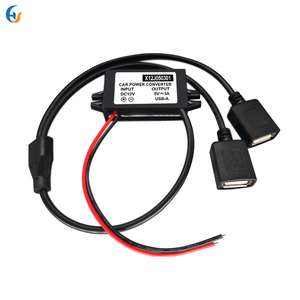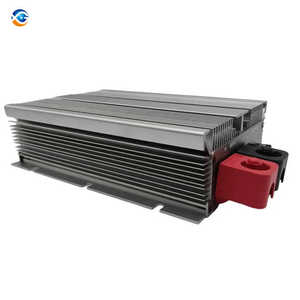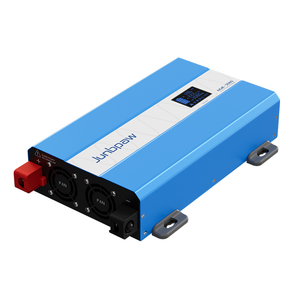
Explore our CE certified, high-density power supply units, pure sine wave inverters, and high-frequency DC/DC buck-boost conversion platforms manufactured under ISO 9001 and EN 50155 standards.
In modern industrial power electronics, traditional hard-switched pulse-width modulation (PWM) topologies are rapidly reaching their physical limits due to parasitic switching losses, extreme electromagnetic interference (EMI), and thermal dissipation bottlenecks. As a premier CE certified resonant converter factory and global exporter, our engineering methodology relies heavily on advanced soft-switching resonant architectures—specifically LLC, LCC, and bidirectional CLLC topologies.
Resonant converters utilize an LC or LLC tank circuit to shape the voltage or current waveform into a sinusoidal structure. By operating at or near the resonant frequency, the power semiconductors (SiC MOSFETs or GaN HEMTs) turn on when the voltage across the switch is zero (Zero Voltage Switching, ZVS) and turn off when current drops to zero (Zero Current Switching, ZCS). This dramatic reduction in switching losses yields distinct operational advantages for industrial procurement:
A core differentiator of our Barcelona-engineered resonant converters is the integration of planar magnetics. Instead of conventional wire-wound transformers, our factory utilizes multilayer Printed Circuit Board (PCB) windings combined with low-loss ferrite cores. In an LLC resonant converter, the transformer's parasitic leakage inductance is precisely designed and utilized as the series resonant inductor ($L_r$). This integration eliminates discrete external inductors, optimizes thermal conductivity across aluminum enclosure chassis, and ensures automated manufacturing repeatability.
| Topological Parameter | Hard-Switched PWM Converters | LLC / CLLC Resonant Converters |
|---|---|---|
| Switching Mechanism | Hard Switching (High $dv/dt$ stress) | Soft Switching (ZVS at Turn-On, ZCS at Turn-Off) |
| Peak Efficiency Range | 88% – 92% | 95% – 98.8% |
| Thermal Dissipation | High (Requires large forced-air heatsinks) | Low (Conduction-cooled enclosure compatible) |
| EMI Profile | Severe harmonic noise, bulky filters | Low harmonics, ultra-clean sinusoidal waveform |
| Power Density | 15 – 25 W/in³ | 45 – 65 W/in³ |
Backed by over four decades of power electronics leadership, 1,000+ custom engineered solutions, and robust European manufacturing standards, we provide complete lifecycle reliability from initial specification to 20+ year fleet support.
Every power conversion platform is designed to strictly adhere to international standards: EN 50155 for rolling stock, EN 45545-2 for fire safety, EN 61373 for extreme shock/vibration, and IEC 62368-1 safety directives.
Our facility features state-of-the-art EMC chambers, climatic thermal stress chambers (-40°C to +85°C), vibration testbeds, and automated burn-in racks. We qualify every design internally before third-party certification audits.
Industrial and railway lifecycles span decades. We offer guaranteed component monitoring, last-time-buy protection, backwards-compatible form-fit-function redesigns, and continuous field maintenance services.
As global industries transition toward electrified infrastructure, microgrids, electric mobility, and automated railway corridors, technical procurement officers must evaluate power converter suppliers against several rapidly emerging macro-trends:
Silicon (Si) switches are increasingly being replaced by Silicon Carbide (SiC) MOSFETs and Gallium Nitride (GaN) high-electron-mobility transistors. WBG semiconductors allow resonant converters to switch at frequencies above 500 kHz to 1 MHz while sustaining junction temperatures over 175°C. Industrial buyers seeking high-density rack-mounted rectifiers or vehicle-mounted inverters should prioritize factories that demonstrate mature SiC/GaN gate-driver design capabilities.
The boundary between power consumer and power generator has blurred. Modern AC/DC battery chargers and DC/DC converters are required to support full four-quadrant bidirectional power transfer (CLLC resonant topologies). This capability allows energy storage systems (ESS), electric locomotives, and industrial battery banks to feed auxiliary power back into the microgrid during peak load shedding events.
Hardware isolation is no longer sufficient on its own. Next-generation resonant power supplies incorporate embedded IoT communication gateways (CANbus, MODBUS, Ethernet/IP, MQTT). By transmitting real-time parameters—such as resonant capacitor temperature, switching frequency drift, input ripple, and output impedance—to cloud dashboards, plant engineers can shift from scheduled preventative maintenance to AI-driven predictive maintenance.
Our R&D division in Barcelona continues to push the boundaries of high-frequency power electronics. Key developments transforming our factory production lines include:
In high-current resonant converters (e.g., 48V to 12V buck converters or 3kW–10kW battery chargers), a single planar core suffers from copper loss concentration. Matrix transformer topologies divide the secondary current among multiple smaller integrated transformer elements embedded directly inside an 8-layer or 12-layer heavy-copper PCB. This balances thermal stress across the substrate and lowers total profile height to under 1U (44.45 mm).
Analog resonant control ICs historically struggled with wide input/output voltage variation, often operating far outside the soft-switching ZVS region under light-load conditions. The integration of 32-bit real-time Digital Signal Processors (DSPs) enables advanced burst-mode control, phase-shift modulation combined with frequency modulation, and dynamic dead-time regulation. This guarantees ZVS across the entire operational envelope from 0% no-load to 150% peak load capacity.
Comprehensive answers regarding compliance, customization schedules, topology selection, and OEM manufacturing capabilities.