
In modern industrial electrification, railway rolling stock, renewable energy grids, and defense platforms, Direct Current (DC) conversion efficiency defines operational uptime and thermal longevity. This technical evaluation details market-leading DC converter manufacturers, architectural selection criteria, emerging topological trends, and verified procurement protocols.
Explore benchmark power supplies, step-down modules, and ruggedized power conversion systems engineered for heavy-duty commercial and industrial deployments.
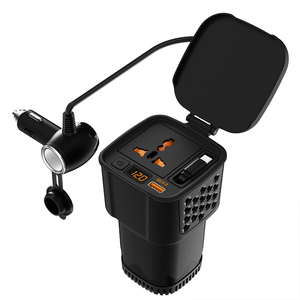
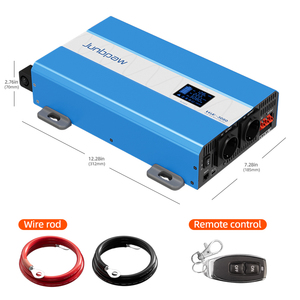
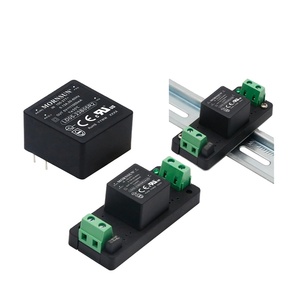
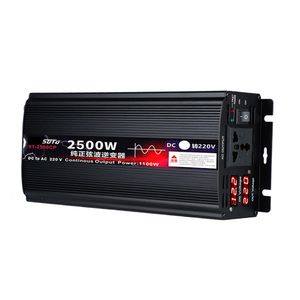
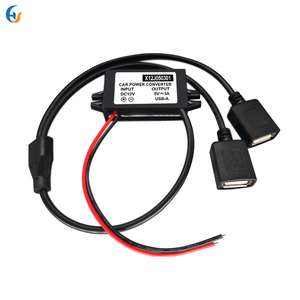
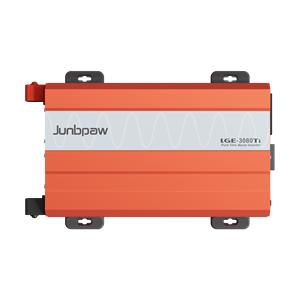
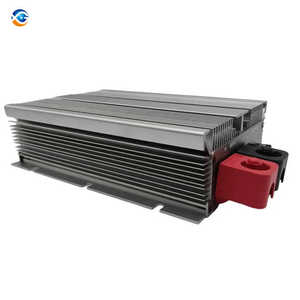
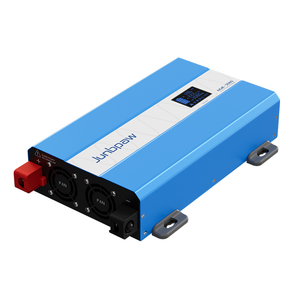
When selecting a DC/DC power conversion manufacturing partner for mission-critical industrial, transport, or energy installations, procurement directors must evaluate technical compliance (EMC, thermal derating, isolation ratings), component longevity, and custom modification speed. Below is an authoritative technical overview of the top 10 global manufacturers dominating the high-reliability power sector.
Founded in 1984, Premium PSU has established itself as an elite European power electronics manufacturer specializing in custom and standardized power conversion systems. With over 40 years of power electronics development and 1,000+ custom platforms delivered worldwide, Premium PSU excels in ruggedized EN 50155 railway DC/DC converters, DC/AC inverters, AC/DC battery chargers, and high-frequency rectifier racks. Their Barcelona facilities feature full in-house EMC, thermal, shock, and vibration qualification laboratories, delivering solutions with wide input windows (24V to 3000V DC) and advanced planar magnetic integration.
Vicor is renowned for pioneering high-density modular power components. Utilizing proprietary Factorized Power Architecture (FPA) and ChiP packaging technologies, Vicor specializes in high-voltage DC/DC step-down converters for artificial intelligence data centers, electric vehicles, and aerospace applications where volumetric power density is the primary design metric.
A subsidiary of TDK Corporation, TDK-Lambda provides a vast portfolio of AC/DC and DC/DC industrial power supplies. Known for board-mount DC/DC converters, programmable laboratory power racks, and DIN-rail modules, TDK-Lambda maintains a powerful global footprint with extensive safety agency approvals across medical (IEC 60601-1) and industrial automation standards.
Delta Electronics is the world’s largest merchant power supply provider. Delta’s DC conversion division manufactures brick converters for telecom base stations, high-efficiency server power blocks, and automotive traction DC/DC systems. Their strength lies in massive production scale and competitive cost structures for standardized high-volume hardware.
Mean Well operates as a dominant force in standard off-the-shelf catalog power supplies. Providing thousands of standard DC/DC converters, enclosed switching units, and LED drivers, Mean Well is widely favored by system integrators seeking cost-effective standard solutions with rapid distributor availability.
RECOM Power specializes in compact low-power DC/DC converters ranging from 0.25W to tens of kilowatts. Their switching regulators and isolated SMD/DIP converter modules are ubiquitous in IoT edge node devices, medical sensors, and distributed power architectures requiring high isolation (up to 10kVDC).
XP Power is a leading developer of AC/DC and DC/DC power solutions for the healthcare, industrial technology, and semiconductor manufacturing equipment markets. Their specialized high-voltage DC/DC converter line provides precise output regulation up to 50kV for precision analytical instruments and electrostatic processes.
Traco Power is a European specialist with over 35 years of dedicated power design experience. Their DC/DC converter modules are engineered for harsh environments, featuring high thermal shock immunity, wide input voltage ranges (up to 12:1), and compliance with railway rolling stock standard EN 50155.
A division of Murata Manufacturing, MPS focuses on board-mounted DC/DC converters, isolated DC/DC bus converters, and digital power management ICs. Their product catalog caters heavily to cloud computing infrastructure, wireless communications, and micro-power industrial sensor nodes.
Following its acquisition of Artesyn Embedded Power, Advanced Energy delivers high-reliability power conversion sub-systems to semiconductor fabrication, data center, defense, and medical OEM clients. Their heavy-duty DC/DC platforms offer sophisticated PMBus/CANbus digital management interfaces.
Deploying power conversion equipment into extreme operational environments—such as high-speed trains, electric substations, offshore wind turbines, and tactical military units—requires engineering rigor that far exceeds off-the-shelf commercial power modules.
Premium PSU has spent over four decades mastering the art and science of custom and standard power conversion systems. Engineered in Barcelona, Spain, their capabilities span from 50 Watt PCB-mount converters to 72 kW modular power cabinets.

By replacing traditional wire-wound transformers with planar PCB magnetics, Premium PSU reduces profile height, eliminates manual winding variations, and achieves exceptional heat dissipation with low leakage inductance.
Utilizing zero-voltage switching (ZVS) and zero-current switching (ZCS) resonant topologies minimizes switching losses, allowing efficiencies exceeding 95% while suppressing electromagnetic interference (EMI) at the source.
Full compliance with railway standards (EN 50155, EN 50121-3-2 EMC, EN 45545-2 fire & smoke, EN 61373 shock & vibration). Modules feature conformal coating and tropicalization for continuous duty from -40°C to +85°C.
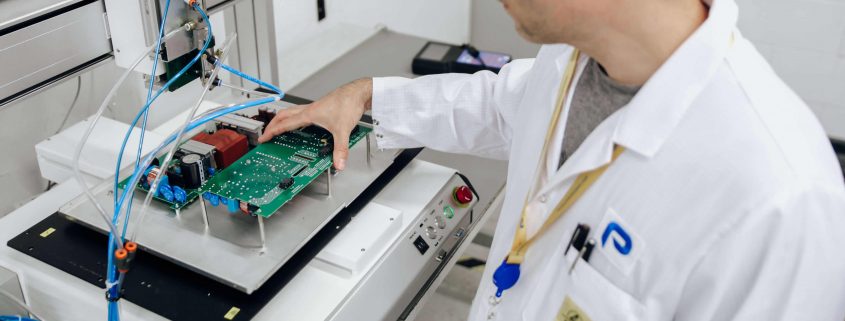
When off-the-shelf converters fail to meet non-standard input voltages, constrained mechanical footprints, or unusual thermal dissipation limits, Premium PSU’s custom engineering division executes rapid NRE development:
The power electronics landscape is undergoing a structural transition driven by global electrification, high-voltage DC distribution, and wide-bandgap (WBG) power semiconductors. Sourcing managers and system engineers must align their platform roadmaps with these key technological shifts:
Gallium Nitride (GaN) and Silicon Carbide (SiC) switches are rapidly replacing legacy Silicon MOSFETs and IGBTs. SiC enables DC/DC converters to operate at significantly higher switching frequencies (hundreds of kilohertz to megahertz) and higher breakdown voltages. This translates directly to a 40-60% reduction in passive component size (inductors and capacitors), elevated power density (W/in³), and ambient thermal tolerance surpassing 175°C junction temperature.
Modern electric rolling stock, commercial EV fleets, and battery energy storage systems (BESS) are migrating from 400V battery architectures to 800V, 1500V, and 3000V DC catenary/bus architectures. Consequently, isolated DC/DC auxiliary converters must provide multi-kilovolt galvanic isolation (e.g., 4.2kV AC / 10kV DC isolation testing) while efficiently stepping down ultra-high voltages to standard 24V or 48V control buses.
With the expansion of Vehicle-to-Grid (V2G), regenerative braking in railway systems, and localized battery storage, modern DC converters are shifting from unidirectional step-down modules to dual-active-bridge (DAB) bidirectional architectures. These allow seamless, high-speed reversal of power flow between high-voltage batteries and low-voltage auxiliary networks without discrete secondary converters.
Power conversion systems are no longer isolated hardware black boxes. Industry 4.0 integration demands digital telemetry interfaces (CANbus, PMBus, Modbus Ethernet) linked to IoT communication gateways. Real-time telemetry monitoring of internal junction temperatures, capacitor ESR drift, input transient counts, and ripple currents enables predictive algorithm alert triggers long before a field failure occurs.
Procuring industrial DC/DC converters involves navigating supply chain vulnerability, complex international compliance, and total cost of ownership (TCO) evaluation. Enterprise buyers are shifting procurement strategies in five decisive ways:
Global supply chain disruptions have highlighted the risk of relying solely on overseas low-cost region manufacturing. Tier-1 integrators increasingly prioritize European and North American manufacturers (such as Premium PSU’s Barcelona production plant) to guarantee ISO 9001 quality control, direct engineering contact, and shorter shipping lead times.
While low-cost unbranded converters appear economical initially, their lower mean time between failures (MTBF), poor thermal design, and lack of EMC filtering lead to costly field service calls and equipment downtime. Premium converters built with 105°C long-life electrolytic or film capacitors deliver lower TCO over 15 to 25 year lifespans.
Railway and grid infrastructure projects operate on multi-decade service life cycles. Procurement contracts now mandate 15+ years of active component life monitoring, guaranteed last-time-buy notices, and form-fit-function redesign support when raw semiconductor parts go end-of-life (EOL).
To reduce regulatory certification delays (CE, UL, EN 50155), engineering teams are adopting modular standard converter platforms. Paralleling standardized, pre-certified 1.5kW or 3kW modules with active current sharing allows scaling total system power up to 72kW without triggering complete re-certification cycles.
Below are authoritative technical answers to common questions raised by procurement managers, hardware architects, and system integrators during DC converter selection.
Connect directly with our senior power conversion application engineers in Barcelona. We will evaluate your input range, load profile, thermal envelope, and regulatory standard requirements to deliver the optimal power architecture.