

Explore field-proven power conversion platforms, solid-state RF amplification units, and C-UAS protective systems tailored for modern electromagnetic defense environments.
Navigating SWaP-C optimization, electromagnetic compatibility, and Gallium Nitride power density in modern electronic warfare and counter-UAS platforms.
In modern military operations, the power supply is no longer merely a passive component; it is the fundamental enabler of radar precision, directed energy deployment, electronic countermeasure (ECM) bandwidth, and tactical communications resiliency. As counter-unmanned aerial systems (C-UAS) and anti-First Person View (Anti-FPV) drone platforms proliferate across asymmetric combat zones, defense original equipment manufacturers (OEMs) face rigorous demands regarding SWaP-C (Size, Weight, Power, and Cost) efficiency.
Selecting top defense power manufacturers requires assessing more than simple output wattage. It demands an evaluation of advanced topology integration—such as Gallium Nitride (GaN) on Silicon Carbide (SiC), planar magnetic integration, three-phase resonant power conversion, and strict adherence to international defense and industrial standards including MIL-STD-810H, MIL-STD-461G, and EN 50155.
A comparative matrix establishing industrial engineering standards for prime defense contractors and procurement officers.
Integration of wide-bandgap materials ensuring >92% efficiency, high power density, and instant RF bandwidth up to 6000 MHz without thermal degradation.
Strict compliance with MIL-STD-461G and EN 50121-3-2 shielding, preventing low-frequency noise emissions from disrupting sensitive sensors.
Conformal coating, IP67 enclosure engineering, and vibration dampening built to satisfy MIL-STD-810H shock and salt-mist specifications.
Advanced conduction cooling, planar heatsink coupling, and phase-change thermal interface materials operating across ambient extremes (-40°C to +85°C).
Guaranteed component availability for 20+ year fleet lifespans with structured last-time-buy plans and form-fit-function redesign pathways.
Direct ownership of climatic chambers, vibration test benches, and full-spectrum EMI/EMC compliance chambers for accelerated qualification.
A forensic engineering review of the 8 core power and countermeasure modules powering modern multi-domain tactical defense installations.
| System Architecture | Frequency / Range | Power Rating | Key Technological Feature | Primary Defense Application |
|---|---|---|---|---|
| UANT UB-MK-1200 GaN | 1160 - 1260 MHz | 10W - 100W Scalable | Wideband VCO / Instant Bandwidth | Anti-FPV & GNSS Spoofing Countermeasures |
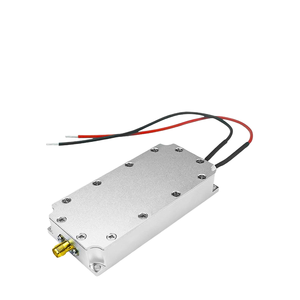
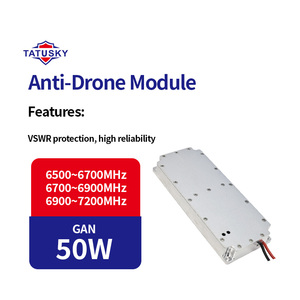
| High-Band GaN C-UAS | 6500 - 7200 MHz | 50W Continuous | Low Harmonic Distortion / High Density | Point Defense C-UAS Electronic Attack |
| Tactical ISM 2.4G Module | 2400 - 2500 MHz | 50W GaN Solid State | High Thermal Efficiency / Compact SWaP | Drone Command Link Disruption |
| 5.2G-5.8G Security Transistor | 5200 - 5800 MHz | 10W Low-Power Module | High Power Added Efficiency (PAE) | Perimeter Security & UAV Shielding |
| 5.2G Long-Distance Shield | 5150 - 5850 MHz | 100W High Power | Deep Penetration Beamforming Coupling | Long-Range Area Denial EW Systems |
| VCO & LoRa Integrated Module | Sub-GHz to 6GHz | 50W RF Output | Telemetry Feedback & LoRa Control | Smart Autonomous Jamming Nodes |
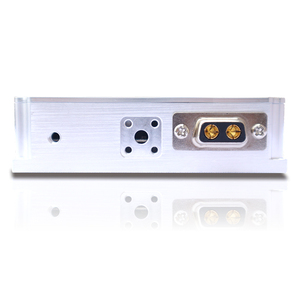
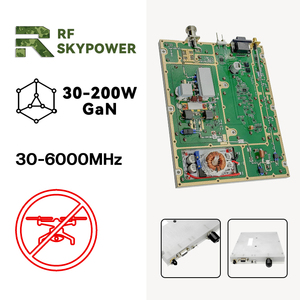
| 30-6000MHz Wideband SSPA | 30 - 6000 MHz | 30W to 200W Modular | Ultra-Wideband GaN Matching Network | Multi-Threat Border Defense Jammers |
| Stab-Proof Tactical Vest | N/A (Personal Defense) | NIJ Level III/IV Equivalent | High Molecular Weight Polyethylene | Field Personnel Physical Protection |
When selecting between ultra-wideband power modules (e.g., 30-6000MHz Instantaneous Bandwidth amplifiers) and band-specific modules (e.g., 1.2GHz or 5.8GHz FPV jammers), system integrators must weigh Power Added Efficiency (PAE) against operational versatility. Narrowband GaN transistors offer PAE figures exceeding 50-60%, reducing heat sink mass and enabling fully sealed IP67 tactical back-pack installations. Conversely, wideband modules employ complex multi-stage impedance matching networks that trade marginal PAE for the ability to defeat frequency-hopping drones across the entire radio frequency spectrum.
Strategic vectors shaping defense procurement, supply chain security, and next-generation power electronics design.
Global defense forces are increasingly mandating open architecture standards such as the Sensor Open Systems Architecture (SOSA) benchmark. Power conversion systems and RF power amplifiers are transitioning toward standardized 3U and 6U VPX form factors. This design approach allows defense procurement teams to hot-swap modules, upgrade GaN power transistors as threat profiles evolve, and eliminate single-source vendor lock-in.
Modern electronic warfare platforms require dynamic power allocation. Rather than broadcasting continuous RF energy across all channels—which generates excessive heat and exposes the emitter to anti-radiation missiles—next-generation power supplies feature high-speed digital control loops (PMBus/CAN bus) capable of pulsing multi-kilowatt bursts to target specific drone threat vectors within microseconds.
Geopolitical friction has highlighted vulnerabilities in semiconductor and magnetics supply chains. Tier-1 defense manufacturers are re-shoring production to qualified facilities within Western and European jurisdiction. Procurement officers are prioritizing manufacturers with in-house magnetics winding, local testing facilities, and transparent component traceability to mitigate counterfeit risk.
For high-power auxiliary units—such as 10kW to 72kW vehicle power generation or base station DC supplies—resonant topologies integrated with planar transformers are replacing traditional discrete transformers. This reduces system volume by up to 40% while raising efficiency above 96%, directly translating to extended operational runtime for remote military installations.
Combining 40+ years of industrial power conversion mastery with military-grade RF technology development.
Founded in Barcelona, our engineering house has designed over 1,000 custom power platforms ranging from 50 W to 72 kW for railway, high-tech industry, energy, and defense.
We maintain internal EMC, climatic, shock, vibration, and high-voltage burn-in testing laboratories, accelerating qualification timelines from years to months.
Our proprietary planar magnetics layout and resonant topologies minimize parasitic inductance, maximize power density, and deliver unmatched thermal reliability.
Key technical and commercial inquiries answered by senior power electronics and RF systems engineers.
Whether you require custom GaN RF power amplification modules, high-density DC/DC converters, or complete MIL-spec power distribution systems, our team is ready to review your specification details.
Get a Quote