
South Korea Railway Electrification & Rolling Stock Power Architecture
South Korea stands at the global forefront of high-speed rail modernization and automated mass rapid transit (MRT). With expansive networks including the KTX (Korea Train eXpress), SRT (Super Rapid Train), the revolutionary GTX (Great Train eXpress) underground commuter system, and complex municipal lines managed by Seoul Metro and Busan Transportation Corporation, the demand for ultra-reliable power conversion hardware has never been higher.
Core Technical Reality: Rolling stock operated in South Korea must withstand severe operating profiles—from peak 25kV AC overhead catenary fluctuations to dense 750V DC / 1500V DC urban transit surges, coupled with humidity extremes (-25°C in severe winter to +45°C ambient summer conditions). Standard off-the-shelf power supplies consistently fail under these localized duty cycles.
1. Overhead Catenary Transients & DC Bus Dynamics in Korean Transit
Korean railway networks operate under two primary electrical distribution standards: 25kV 60Hz AC for high-speed intercity corridors and 1500V DC (or 750V DC for third-rail light rail lines) for regional metros. Auxiliary Power Supply Units (APUs) and static inverters (SIVs) deployed on rolling stock must accept extremely wide input voltage fluctuations while preventing voltage drops from affecting Train Control and Monitoring Systems (TCMS), brake controls, and cabin environmental controls.
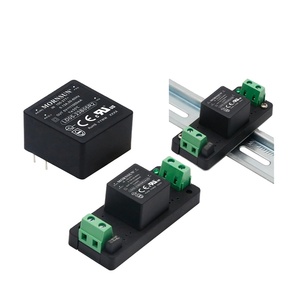
Our OEM/ODM railway power converters integrate multi-stage active clamp topologies and wide 4:1 / 2:1 DC input stages capable of absorbing severe RIA 12 transients (up to 3.5 times nominal voltage for 20 milliseconds) without interruption or component degradation. By utilizing integrated planar transformers and low-loss Silicon Carbide (SiC) semiconductors, our design achieves over 94% full-load efficiency across nominal voltages ranging from 24V, 37.5V, 72V, to 110V DC battery buses.
| Nominal Input Voltage | EN 50155 Input Range (Continuous) | Transient Voltage Window (0.1s - 1s) | Typical Korean Rail Application |
|---|---|---|---|
| 24V DC | 16.8V – 30V DC | 14.4V – 33.6V DC | Trackside CBTC Controllers & Emergency Lighting |
| 72V DC | 50.4V – 90V DC | 43.2V – 100.8V DC | Urban Metro Auxiliaries & Locomotive Cab Display Systems |
| 110V DC | 77V – 137.5V DC | 66V – 154V DC | KTX / SRT Passenger Coaches, HVAC Control & SIV Modules |
| 750V / 1500V DC | 500V – 1800V DC | 400V – 2100V DC | Direct Catenary Auxiliary Inverters & Substation Chargers |
2. EN 45545-2 Fire & Smoke Safety & Shock Resistance (EN 61373)
South Korean railway safety protocols, heavily enforced by the Korea Railroad Research Institute (KRRI) and local transit authorities, enforce strict compliance with EN 45545-2 (Hazard Levels HL2 to HL3) for flammability, smoke density, and toxicity. Power conversion units mounted inside passenger compartments, under-floor chassis, or roof racks must strictly utilize halogen-free, self-extinguishing potting materials and high-temp PCB substrates.
Furthermore, structural reliability under EN 61373 Category 1 Class B (Body Mounted) and Category 2 (Bogey Mounted) requires robust mechanical design. Our custom enclosure options utilize heavy-duty extruded aluminum chassis with potted magnetic components, locking mechanical fasteners, and conformal coating against moisture, salt spray, and conductive metal dust inherent to wheel-rail friction in underground tunnels.